Friday, 30 September 2011

More spiritual books for kids

After I posted the previous article about spiritual books for kids, lots of people suggested more books that I had forgotten to include. And some of them were my favourite books.

The Secret Garden by Frances Hodgson Burnett

This is a story of an orphaned girl who discovers the beauty of the Yorkshire Moors, the value of friendship, and the magic of gardening. The main characters - Mary, the protagonist, Dickon the child of Nature, and Colin the intellectual are unforgettable; and the minor characters such as Ben the gruff gardener and Dickon's mother, are beautifully drawn too.

The Moomin series by Tove Jansson

Moominvalley is located on the edge of the Gulf of Finland, and the creatures that live there include Moomins, Hemulens, Fillyjonks and their friends. They have a series of adventures; the stories mostly focus on Moomintroll and his friendship with Snufkin, who is a wanderer who doesn't like to have too many possessions, and is almost Zen Buddhist in his thinking. The whole series has a wistful and charming tone, a keen observation of Nature, and the books are beautifully illustrated.

The Iron Wolf by Richard Adams

This is a collection of folktales from all around the world, rewritten for children. One of my favourites is an Italian story about how the birds got their colours, but all the stories are well-written and enjoyable.
'Authors need folk-tales,' Richard Adams says, 'in the same way as composers need folk-song. They're the headspring of the narrator's art, where the story stands forth at its simple, irreducible best. They don't date, any more than dreams, for they are the collective dreams of humanity.'
Watership Down by Richard Adams

The gripping story of the journey of five rabbits who escape the destruction of their home warren after Fiver (a shaman-rabbit) has a vision of its impending doom. The friendship of the rabbits, the visionary experiences of Fiver, and the legends of El-Ahrairah, the trickster rabbit hero (who bears more than a passing resemblance to human trickster gods), make this a magical and unforgettable story.

Strandloper by Alan Garner

The story opens with a group of people holding a curiously pagan folk ritual in a church. One of them, William Buckley, has learnt to read, which is regarded as a subversive crime; and he is transported to Australia for blasphemy, where he escapes from the penal colony and goes to live with Aborigines. This is a very evocative look at the similarities and differences between English folk mythology and Australian Aborigine mythology, and the differences between folk religion and revealed religion. The English section of the story is based fairly closely on the facts.

Hide and Seek with God by Mary Ann Moore, Skinner House, 1994
- 29 enchanting tales for four- to eight-year-olds.
- For today's children, a religious vision that is multicultural and non-sexist.
- Includes suggestions for talking about God with children without using dogma
- God comes to life as many things — transcendent mystery, spiritual force, the mother and father of life, peace, and silence, and lightness and darkness.

Wednesday, 28 September 2011

"Yom Kippur" a Gentiles lesson: At-One-Ment

“Yom Kippur” a Gentiles lesson: At-One-Ment

From next Friday night until Saturday at sunset 7th – 8th of October millions of Jewish people, throughout the world, will be celebrating the festival of Yom Kippur “The Day of Atonement”.

According to Jewish tradition, God inscribes each person's fate for the coming year into the Book of Life on Rosh Hashanah and waits until Yom Kippur to "seal" the verdict. During the Days of Awe, a Jew tries to amend his or her behaviour and seek forgiveness for wrongs done against God and against other human beings. The evening and day of Yom Kippur are set aside for public and private petitions and confessions of guilt. At the end of Yom Kippur, the Jewish person is considered oneself absolved by God and therefore can then be placed in the “Book of Life” for another year.

What is significant for me, as a gentile, about this concept of atonement is that the wrong doer must first of all seek forgiveness from those they have wronged before they then turn to God and ask that they be returned to the “Book of Life”. Only after the transgressor has been forgiven by the transgressed can God’s forgiveness be obtained.

So what can be learnt from this tradition and understanding of atonement? Well for me it stems from this idea of coming into right relationship, not only with God but also the rest of humanity and life itself. Experience has taught me that through coming into right relationship with other people and life in general, I begin to come into right relationship with myself and then and only then do I began to experience the power that I call God. This seems to go against much of what the faith traditions teach, but it is definitely my experience, God it seems came last. My experience of God has been revealed through an attempt to live honestly and openly which began by me being able to see where I had been wrong. It began to be experienced as I dropped those barriers of self protection I had built up over the years.

Now I could share hundreds of examples of how my internal walls have “come a tumbling down” over the years, some appear mind blowing and others are really quite simple. The one I will share here may not sound very significant to most folk, but it meant a lot to me.

For most of my adult life I was one of those people who could never admit to be being wrong. I could say sorry but I could not admit to being wrong. I would argue and argue until I convinced the other that I was right. I remember once persuading a very intelligent friend of mine that the water in Yorkshire is somehow better than it is in Lancashire. It took me hours but she did eventually come round to my point of view. The argument was utterly pointless but there was no way my esteem would allow me to concede defeat.
This though began to change during an exchange I had with another friend about 7 years ago now. I was spouting my mouth off about something, really showing off if I’m honest, when my friend corrected me and explained what the real truth of this particular situation was. Now in my guts I wanted to fight and argue, but for once I did not. I stopped and listened and realised that I was incorrect. I then admitted I was wrong and do you know what it didn’t matter. Now there was a lot of change occurring within me at this juncture in my life and this small incident pieced a lot of it together. I suddenly realised that by admitting I was wrong about one thing it did not mean that I was wholly wrong about everything. I had developed enough honest self esteem to realise that being wrong about one thing did not make me wrong full stop; it did not make me wrong to the core of my being, which I believe had been the problem all along. I could not lose an argument because if I did it would prove to me, what I really believed that I was wrong to the core. I do not believe that any of us is wrong to the core.

It also taught me something else, which for some reason had passed me by before...once you can see you are wrong, admit to being wrong and do what is required to correct what was wrong, you are no longer wrong...you are right again; you are at one, you have atoned.

Let me just repeat that...because I need to remember this...

once you can see you are wrong, admit to being wrong and do what is required to correct what was wrong, you are no longer wrong...you are right again; you are at one, you have atoned.

That said to be able to accomplish this requires the development of natural self esteem, which I have discovered only develops by living honestly. I realised some time ago that you cannot work on self esteem itself by telling yourself how wonderful you are, it just doesn’t work. It can only grow naturally by living honestly from the core of your being and by healing the relationships between yourself, the rest of humanity, life and whatever we understand is at the core of it all.

I have discovered that the essence of atonement is to bring life back into relationship. As Peter Sampson (one of my all time favourite Unitarians, or do I mean Lunitarians) once taught me Atonement literally means At-One-Ment... “Atonement literally means At-One-Ment.” It is the quality of being the one undivided whole. So if atonement means being the one undivided whole then the opposite is this sense of separation, this experience of fragmentation which can occur within ourselves, within our wider society and within that which holds all of life together. So this healing of not only ourselves but humanity and all of life simply begins by first of all admitting where we have been wrong as individuals. By the way this takes courage and true faith. It is a healing process that begins to break down the barriers that separate us from one another.

Many people are estranged from one another, both within families and communities. Who is no longer friends with someone because of a quarrel that got out of hand?

I have been estranged from many members of my family for long periods at different times of my life. This is no longer the case I am united with all of them today. We were brought back to this state of at-one-ment because I was willing to level my own pride and make the first move. I was willing to atone for the wrongs I had done and able to forgive the harms that had been done to me and to others too.

And isn’t this the case for all of us. We can all feel uncomfortable by some individuals who we have fallen out at some time and place in the past often we don’t remember why and yet we can become enslaved by the memory of these slights. This anger affects all who are around us and this sense of negativity breaks up any sense of true community. And yet we could easily begin the healing process if we could just admit where we have been wrong. That though of course leaves us vulnerable to criticism and I believe that this is what we are most afraid of. I know I was and can still be so from time to time. Fear of criticism has always been my greatest downfall.

This concept of atonement does appear out of synch with our 21st century world. Our culture tacitly encourages us to cover up, deny, forget our lies, our indiscretions, and our exploitation of others. Our media is full of public figures behaving in this manner. Many only genuinely offer regret and occasionally ask forgiveness when there is nowhere else to go. Rarely is the apology directed at the person or persons harmed. More often it is directed towards the general public who the figure is frightened of losing their support of. How many times have we heard celebrities’ apologies to their fans for letting them down? Not for what they have actually done.

This is not atonement by any stretch of the imagination. This is not at-one-ment! A genuine apology expresses remorse when it is directed to the person hurt and is given with the intention of seeking to be in an honest relationship with ourselves and others. It is an acknowledgement of personal wrongdoing. It is an attempt to make amends, to heal to put right what is wrong. It also carries the intention to change and grow from the person making amends.

I like the Jewish concept of atonement, it seems so human centred. I am sure that in practises many Jewish people fail to live up to its true ideals, but then who amongst us ever truly walks the path that we talk about. I know for one that I do not. I am able to acknowledge my short comings and to bring myself back into relationship with those I share my life with. I am much freer today of the old bondage of perfectionism fuelled by the fear of criticism. I have learnt a lot from seeing where and when I am wrong. By the way I am also able to see and acknowledge when I am right (I will talk more about that in my next post). All these things have brought me closer to the rest of humanity and begun to heal that aching loneliness that was at the core of me for so long. Finally and vitally it has begun to return me to the love that I understand to be God.
Remember Atonement means At-One-Ment!

Thank you Mr Sampson for teaching me that Atonement means At-One-Ment and everyone else who has opened my eyes as we have walked along life’s rich and Broad Highway.

Friday, 23 September 2011

New UKS mobile site

UKSpirituality now has a mobile site, optimised for mobile users. Take a look!

You can view event listings, resources, spiritual practices, and a random quote of the moment.

We will be adding more functionality (specifically the ability to register for events) soon.

If you access our main website with a mobile browser, you will be redirected to the mobile site, but you can opt out and use the main site if you prefer by clicking on "Exit mobile site" at the bottom of the mobile page.

Friday, 16 September 2011

Spiritual books for kids

Do you ever wonder how to introduce your kids to spirituality without pushing it on them? Of course, they'll quite probably discover it for themselves, but maybe they won't mind a helping hand.

Here are some of the books that I found inspiring as a child, and some that I have discovered since.

Illustrated books for younger children


The Little Prince by Antoine de Saint-Exupéry

I love this book so much that I bought the French edition as well (it was originally written in French). It's a poignant story of how an aviator who has crashed in the desert meets a traveller from another planet - the little prince who lives on the asteroid B612. The little prince tells of his travels from one asteroid to another. The story is quirky and charming, but also sad and wistful.

Google Books · Wikipedia


The Whales' Song by Dyan Sheldon and Gary Blythe

This is a lovely book with beautiful illustrations and the evocative story of Lily, a small girl who lives with her grandmother. Her grandmother tells her stories about the whales, and how beautiful they are.

It is presumably meant to be read aloud to small children, but it is enjoyable for all ages.

Amazon.co.uk · GoodReads


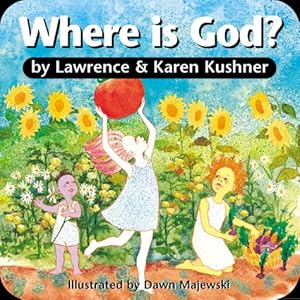
Where is God? by Lawrence and Karen Kushner

A review by B Keeper on Amazon.com says it all really:
Kushner's Where Is God is a wonderful introduction to the concept that God's presence infuses nature and all human exchanges and experiences. I actually prefer this board book to the full-size, older-children's book it is drawn from (Because Nothing Looks Like God), because the board book forces one to linger on the poetry of the text and the tenderness of the cropped illustrations. I get choked up almost every time I read this little book to my two-year-old son, simply because it is so simple and so true, and because I feel it expresses exactly my belief about God's immanance and the joys of being human here on earth.
Lawrence Kushner is a Reform rabbi and currently the scholar-in-residence at Congregation Emanu-El in San Francisco, California.

Amazon.co.uk · Lawrence Kushner


Jonathan Livingston Seagull by Richard Bach

An absolute classic ever since it was published, Jonathan Livingston Seagull is the story of a gull who is not like other gulls. He lives to fly rather than to eat. Eventually he is shunned by the other gulls, until some come to learn from him. This is a story of individuality and courage, beautifully illustrated with pictures of gulls in flight.

GoodReads says:
People who make their own rules when they know they're right...people who get a special pleasure out of doing something well (even if only for themselves)...people who know there's more to this whole living thing than meets the eye: they'll be with Jonathan Seagull all the way. Others may simply escape into a delightful adventure about freedom and flight.

Longer books for older children


The Earthsea Quartet by Ursula Le Guin

This is a wonderful series of books on how to use magic responsibly, with unforgettable characters, beautiful seascapes, and an excellent style of writing. The author is a Taoist, and the philosophy of Taoism is evident in the unfolding of the story (but never in a heavy-handed way).

Ged, a mage from a remote island, goes to wizard school on Roke, but one day when he is showing off his powers to the other students, he brings a terrible thing into the world: a gebbeth. He must go on a quest to track it down. On his journey, he has wonderful adventures and meets a dragon and an unhappy priestess.

Amazon.co.uk · Fantasy Book Review · Ursula K Le Guin


Witch Child by Celia Rees

Aimed at teenagers, this is a story of a girl whose grandmother is hanged for witchcraft, and who must then make her own way in a world of fear and superstition. Celia Rees writes beautifully of landscapes and customs, but the book is gripping from start to finish.  There's also a sequel, Sorceress.
"compelling and convincing.Rees has become a major writer for teenage readers." Independent 
"every now and then one reads a book which stirs up the deepest of feelings and continues to cause ripples and this book is just such a one" School Librarian Journal
Amazon.co.uk · Celia Rees

The Secret Life of Bees by Sue Monk Kidd

Lily is a lonely motherless girl who lives in South Carolina and is visited by bees. After her friend Rosaleen is beaten up for registering to vote, they run away and find happiness from an unexpected connection from the past.

This novel has also been made into a film directed by Gina Prince-Bythewood.

Amazon.co.uk · Sue Monk Kidd

Monday, 22 August 2011

What is spirituality?

Spirituality has memorably been described by Lucy Bregman as "a glowing and useful term in search of a meaning".

So, what is it? Does it imply the existence of a spirit or a soul, or of deities? No, not necessarily. You can be spiritual without being religious (and you can be religious without being spiritual). Religion is often regarded as outward conformity to a particular religious system, its beliefs, practices and values, whereas spirituality is the inner sense of connection, a more instinctive and intuitive way of life.

I regard spirituality as a sense of mystical connection with the universe and all beings within it. It can be inspired by nature, science, art, poetry, liturgy and ritual. In feeling this sense of connection, we experience compassion for the sufferings of other beings, and empathy with their joys.

We can enhance this sense of connection by finding a community with whom we can practice compassion and mindfulness; if we don’t engage in spirituality in a community setting, it can become self-centred and shallow, disconnected from everyday reality. We need the experience of actually living and sharing with others to enable us to grow and become our authentic selves. This can be done by the creation of a community of shared values, which models in microcosm the desired qualities of human community. Of course there will be conflicts and tensions, but it is in how these are resolved that the real values of the community will be tested and refined. It is only by this kind of radical openness and humility that the spiritual community can become strong and genuinely inclusive.

Practising spirituality in community could be called religion (a word that simply means to reconnect, or to reinterpret). In liberal religion, where the "divine" is usually viewed as immanent in the world, or as so diffuse that it's not a person, the source of authority is viewed as the self (as in one's conscience) and not a "higher power". Adherents of liberal religions (such as Unitarians, Pagans, Quakers, Buddhists, Liberal Jews and many others) regard differences of belief as interesting and stimulating, challenging us to broaden our minds. Mysticism, spirituality and spiritual practices are encouraged in these traditions.

Thursday, 18 August 2011

New resources on UKSpirituality

New resources in Atheist Spirituality:
A new addition to the Buddhist quotations section:
Do not believe in anything (simply) because you have heard it.
Do not believe in traditions because they have been handed down for many generations.
Do not believe in anything because it is spoken and rumored by many.
Do not believe in anything (simply) because it is found written in your religious books.
Do not believe in anything merely on authority of your teachers and elders.
But after observation and analysis, when you find that it agrees with reason, and is conducive to the good and benefit of one and all, then accept it and live up to it.

~ Gotama Buddha
It would be great to add more to the atheist spirituality section, so if you have a suggestion, please send it in.

Monday, 15 August 2011

Hope not Hate: A Universalist's Response

“You may possess only a small light, but uncover it, let it shine, use it in order to bring more light and understanding to the hearts and minds of men and women. Give them not Hell, but hope and courage. Do not push them deeper into their theological despair, but preach the kindness and everlasting love of God.”
John Murray
These words by John Murray have been ringing in my ears these last few days.

We need hope more than anything at this moment and we need courage. We are all being challenged by despair and at times hatred.

We have all witnessed the rioting and looting and wanton destruction in some of our cities, although not all. Watching the news last week you would think the whole country had gone up in smoke, when in truth it was isolated to certain areas.

We all witnessed the horror of the gunning down of children in Norway; we have seen the phone hacking scandal and the corruption of journalist, the metropolitan police as well as politicians and public figures; we continue to see war and conflict in north Africa, violence in the middle east and famine in the Sudan, exacerbated by its own government;

We have seen the death of a talented singer, to the disease of addiction. It would be so easy to turn away and give up on life... I know I have been tempted to do so from time to time.

I have also felt, as I am sure we all feel sometimes, the need to condemn to blame to turn again to hate. And then I look in the mirror and remember the words of Jesus “Let he who is without sin cast the first stone”; and then I have to be honest and say that yes I too have hated and I too have hurt others. This is not me condoning what has happened, just remembering that I share a common humanity with these rioting youths and corrupt politicians, and terrorists and journalists and soldiers, and addicts and the homeless and the mentally ill. I could be anyone of them and know at times I have been some of them. I have certainly lived in despair and perhaps even hated enough to kill. I am human I am not immune from such emotions, I share a common humanity with these very same people. We all do.

In the very same cities where the violence erupted we have seen people coming together; people from all walks of life, at one, in community. There have been peace vigils in all the major cities where rioting took place; people from all walks of life, sharing in their common humanity.

I would imagine only someone completely lost in their own hatred could have failed to have been moved by the example of Tariq Jehan, father of one of the three young man who were mowed down in Birmingham attempting to protect their community. This man did not speak of retribution or reprisal; yes he obviously wants justice, but not revenge. Instead he spoke of our common humanity and the need for communities to come together. Here is a man of faith and love and compassion and his light has definitely shone brighter than any flame this week.

The Norwegian response to the killing of 77 people, 69 of them young activist on a summer camp is another example of hope triumphing over hate. What do we see from Norway’s politicians? We see them uniting together in partisanship for the coming election. The aim of the killer was to attack Norwegian multi-culturalism and tear the nation apart. How have the people responded? They have come together in unity and mutual support in response to the violence and horror. It will not bring the lost lives back, of course it will not, but it would seem that love and hope is prevailing in the aftermath of such horror.

It would be easy to despair at humanity and yet I see hope everywhere.

I am a Universalist, in both the old meaning of the word and its more modern incarnations. I both believe and experience a God of love who accepts all and rejects none; is present in all life and yet is greater than the entirety of all. I also believe that there are many ways to understand and experience this universal love. I do not believe that there is only one way. Universalism has given me a code of hopefulness that I can live by. It sustains me through the vicissitudes of life.

My Universalism is a living breathing faith and helps me make some sense of the world in which I live. It helps me to make some sense of both hope and despair, emotions that are with us all. Universalism does not separate them. They are joined at the hip; they are like Siamese twins, who depend on one another for life.

In the French language hope (espoir) and despair (désespoir) share the same root. From this it seems reasonable to conclude that the opposite of hope is not actually despair but indifference. Indifference is to live without feeling or passion or care, to fail to respond to the pain and or suffering around, to deny our link to one another, to fail to feel another’s pain, to care less. Yes people in the midst of despair struggle and may even want to give up, but they keep on, hope is never too far away. Hope and despair are two branches formed from the same root of the one tree.

Universalism is a hope filled faith, but that does not make it an easy path. It is not about sitting back and waiting to be rescued by the God of Love it promotes. Instead it declares that salvation, in this life, can only be achieved by facing up to the suffering present in all our lives and dealing directly with the despair that accompanies it.

There are those who accuse we hope filled Universalists as being nothing more than “Pollyannas”, I have had this accusation thrown at me. Is this true? I certainly do not deny the pain of life, quite the opposite I have learnt that love and beauty can only truly be found in the very muck of life itself, this is where the pearls and diamonds are found. Hope is found through honestly living through the vicissitudes of life.

We are all responsible for creating the world in which we live. We bought the newspapers that tapped into the phones of people; we all played our role in creating the current financial crisis. can any one of us truly claim innocence? I know that I can not.

I believe that the Brahma Kumaris hit the nail on the head in this recent public response to the rioting:
“Greed, inhumanity, and lack of integrity in the pursuit of financial or political gain are hardly the preserve of the young rioters. Young people are particularly susceptible to the myth peddled to them by society that happiness lies in material gain; this has left a huge vacuum inside with nothing to fill it.”
We can all point the finger and blame others for the current state we are in, but we all share a common humanity. We are all responsible for the state we are. I will certainly hold my hand up and accept my responsibility. Therefore we are all responsible for the solution, which has already begun by communities coming together. In the very despair of our current situation there is hope.

I have felt incredible sadness at times these last few weeks as I have witnesses the many horrors we inflict on one another, but I live with hope which I believe can fill the vacuum in our world. I will not turn away and sink into depression, which these days I understand differently to sadness.

Sadness is an emotion which any fully connected and therefore awakened human being must feel. If a person never feels sadness or pain, then they never feel love either. Depression on the other hand is something very different. More often than not it is the result of becoming trapped in self pity or crippled by despondency. Sadness is a naturally occurring irremovable part of our humanity, where as depression can be lessened and even totally eliminated, if correctly treated. Sadness can bring us together in our shared humanity, where as depression keeps us apart and in isolation. Sadness breeds hope; depression suffocates it.

Sadness is an emotion that we need as we look out at some of the terrible destruction and corruption witnessed over these last few weeks. It is an emotion I myself have felt many times, but it has not brought with it hopelessness. I have also felt it during conversations with those nearest and dearest to me; people struggling with the pain of their own lives. I have tried to be with my loved ones but I have not found it easy at times and I know that I have failed them on occasion, I am not immune from diffidence. Sometimes other people’s pain can be just too much.

I also know what it is like to live without hope. I have been the slave of addiction and I have been constrained and trapped by depression. I have hated myself and I have hated my world, but not anymore. I have found love and I have found hope, in the midst of despair. I found it by searching the through the muck of my own life. That great reality deep down within every single one of us.

So to echo, but to slightly alter, the sentiments of John Murray. Let’s give our world hope and not hate. Let’s follow the examples all around us in our own cities and our towns, lets live lives of love and connection.

Love will prevail...

“What the world needs now, is love sweet love"