Showing posts with label children. Show all posts

Thursday, 6 October 2011

"Ithaca": The Beautiful Journey & National Poetry Day


Today, 6th October 2011 is National Poetry Day. Due to this I thought I would publish this reflection inspired by one of my favourite poems “Ithaca” by Constantine P Cavafy. Here read by Sean Connery.

No one can honestly say that can they predict the future, where life will lead us. What we will end up doing or where we will end up going and who we will end up with. We do not know who we will meet along the way and we don’t know what these folk will give or perhaps take from our lives. Some people we will meet only once and never again; some will stay with us a short while and others will be with us until the day our bodies breathe their final breath, but we do not know who these people are the day we are born.

It’s much the same with situations. Some we may experience only once, many we may never experience and others we will continue to experience over and over again. At the beginning of our lives we can not predict what these are and would we really want to even if we could?

I do not personally believe that these are preordained either, before we were born. Do not get me wrong I am not an atheist I have a strong faith in a force that runs through life, that I call God. That said the God of my understanding does not control all life and does allow it to develop freely. For me God offers the Lure of Love to all life but does not control every interaction.

Eight years ago today 6th October 2003 the final stages of a part of my journey were just beginning to end. I entered into what I can only describe as a living hell. Thankfully I came out of this on 10th October 2003 and I have never really been the same man since.

How often have we heard the phrase “Life is a journey”? Sometimes beautiful; sometimes frightening!

For all of us at times just to simply step out into the world takes all the courage we can muster. Past experiences can often stop us dead in our tracks. Fear can block our attempts to step out into the world and back into the adventure of life with all its many challenges. Fear is always present to stop us to block us along the way.

Human history is littered with stories and adventures inspired by the search for treasure and or wisdom Whether these adventures be Jason and the Argonauts or many of the other Greek tales, Pilgrim's Progress, Gulliver’s Travels, The Wizard of Oz, Jack and the Beanstalk, The Lord of the Rings - the list is endless. Human history is littered with folk tales and myths which teach us so much about what life is in all its potential both for beauty and horror

Joseph Campbell who spent years exploring such myths believed that these stories helped us to fully understand how we are often called out into new adventures in our lives. He identified four distinct stages of the journey. The first stage Campbell named “The Call to Adventure”. This he claimed is caused by discontent, which draws us out of the comfort of our lives to risk something new; the second stage is a form of initiation where goes through a series of ordeals that test their mental and physical skills; The third stage is the time of revelation the discovery of truth and treasure; the final stage is the return to one’s community. With wisdom gained and with treasure to share.

Throughout our lives we are constantly called out and challenged to the adventure. I have learnt that in order to succeed in this requires faith in life itself and a sense of openness and courage to overcome the challenges that can come our way. I have learnt that the key is not to bring our own monsters with us along the way and therefore just deal with what we meet on the road.

This I believe is what the poem Ithaca is hinting at when it says:
When you set out on your journey to Ithaca,
pray that the road is long,
full of adventure, full of knowledge.
 
The Lestrygonians and the Cyclops,
the angry Poseidon -- do not fear them:
You will never find such as these on your path,
if your thoughts remain lofty, if a fine
emotion touches your spirit and your body.
The Lestrygonians and the Cyclops,
the fierce Poseidon you will never encounter,
if you do not carry them within your soul,
if your soul does not set them up before you.
Most of the demons that got in my way a few years back were not real at all, but merely fears created from my own past. They made me afraid to try; therefore I ignored the call to adventure for so long. You see the call itself is not enough, there also needs to be faith in the adventure itself that it will be a joy and one worth taking.

This faith comes naturally to children because they have not yet learnt to fear life. I believe that Jesus his hinting at this in Mark 10 v 15. Here Jesus states:
"Let the little children come to me, and do not hinder them, for the kingdom of God belongs to such as these.

I tell you the truth, anyone who will not receive the kingdom of God like a little child will never enter it."
He is really speaking to his disciples and through this the author of Mark is telling us something of what faith must be, it must have an openness and be an almost innocent faith that the adventure that is life is worth taking. Of course it is talking specifically about Christian faith here, but for me this is a universal principle.

Neither is the call to adventure really about the potential treasure that can be found at the end of it, rather the treasure in it. The poem Ithaca is certainly hinting at this. It is telling the reader to keep “Ithaca”, the call, in mind. It is also telling us that it’s not really the destination but the adventure itself that is the treasure. It ends by saying:
Ithaca has given you the beautiful voyage.
Without her you would have never set out on the road.
She has nothing more to give you.
 
And if you find her poor, Ithaca has not deceived you.
Wise as you have become, with so much experience,
you must already have understood what Ithaca means.
The key is the adventure, and to maintain that adventurous spirit. To live with the eyes of and heart of a child, to maintain that sense of awe and wonder that comes so naturally to them. Often in life the greatest gifts can come from the worst horrors, that has certainly been my experience.

How often has it been said that life is what you make it. For me this doesn’t mean you can have whatever you want in life and do whatever your heart desires. In my experience this is not true. That said whatever horrors may be bestowed upon us, something wonderful and beautiful can come from them, if we can only find and maintain that spirit that Jesus saw in children.

As for the destination well who knows the answer to that, certainly not me. I suspect there is more beyond this physical form but I cannot say for certain. In any case that should not stop us from enjoying the adventure we are on now, from learning from it and passing that knowledge on to those we meet further down the road. Wherever it may lead us.

No one can predict the future. I do not believe it has already been written. Personally I think it is better that way. To want to know what will happen is just another form of human vanity that is inspired by a fear without faith.

I’ve grown accustomed to the uncertainty.

Chaos rules ok.

Friday, 30 September 2011

More spiritual books for kids

After I posted the previous article about spiritual books for kids, lots of people suggested more books that I had forgotten to include. And some of them were my favourite books.

The Secret Garden by Frances Hodgson Burnett

This is a story of an orphaned girl who discovers the beauty of the Yorkshire Moors, the value of friendship, and the magic of gardening. The main characters - Mary, the protagonist, Dickon the child of Nature, and Colin the intellectual are unforgettable; and the minor characters such as Ben the gruff gardener and Dickon's mother, are beautifully drawn too.

The Moomin series by Tove Jansson

Moominvalley is located on the edge of the Gulf of Finland, and the creatures that live there include Moomins, Hemulens, Fillyjonks and their friends. They have a series of adventures; the stories mostly focus on Moomintroll and his friendship with Snufkin, who is a wanderer who doesn't like to have too many possessions, and is almost Zen Buddhist in his thinking. The whole series has a wistful and charming tone, a keen observation of Nature, and the books are beautifully illustrated.

The Iron Wolf by Richard Adams

This is a collection of folktales from all around the world, rewritten for children. One of my favourites is an Italian story about how the birds got their colours, but all the stories are well-written and enjoyable.
'Authors need folk-tales,' Richard Adams says, 'in the same way as composers need folk-song. They're the headspring of the narrator's art, where the story stands forth at its simple, irreducible best. They don't date, any more than dreams, for they are the collective dreams of humanity.'
Watership Down by Richard Adams

The gripping story of the journey of five rabbits who escape the destruction of their home warren after Fiver (a shaman-rabbit) has a vision of its impending doom. The friendship of the rabbits, the visionary experiences of Fiver, and the legends of El-Ahrairah, the trickster rabbit hero (who bears more than a passing resemblance to human trickster gods), make this a magical and unforgettable story.

Strandloper by Alan Garner

The story opens with a group of people holding a curiously pagan folk ritual in a church. One of them, William Buckley, has learnt to read, which is regarded as a subversive crime; and he is transported to Australia for blasphemy, where he escapes from the penal colony and goes to live with Aborigines. This is a very evocative look at the similarities and differences between English folk mythology and Australian Aborigine mythology, and the differences between folk religion and revealed religion. The English section of the story is based fairly closely on the facts.

Hide and Seek with God by Mary Ann Moore, Skinner House, 1994
- 29 enchanting tales for four- to eight-year-olds.
- For today's children, a religious vision that is multicultural and non-sexist.
- Includes suggestions for talking about God with children without using dogma
- God comes to life as many things — transcendent mystery, spiritual force, the mother and father of life, peace, and silence, and lightness and darkness.

Friday, 16 September 2011

Spiritual books for kids

Do you ever wonder how to introduce your kids to spirituality without pushing it on them? Of course, they'll quite probably discover it for themselves, but maybe they won't mind a helping hand.

Here are some of the books that I found inspiring as a child, and some that I have discovered since.

Illustrated books for younger children


The Little Prince by Antoine de Saint-Exupéry

I love this book so much that I bought the French edition as well (it was originally written in French). It's a poignant story of how an aviator who has crashed in the desert meets a traveller from another planet - the little prince who lives on the asteroid B612. The little prince tells of his travels from one asteroid to another. The story is quirky and charming, but also sad and wistful.

Google Books · Wikipedia


The Whales' Song by Dyan Sheldon and Gary Blythe

This is a lovely book with beautiful illustrations and the evocative story of Lily, a small girl who lives with her grandmother. Her grandmother tells her stories about the whales, and how beautiful they are.

It is presumably meant to be read aloud to small children, but it is enjoyable for all ages.

Amazon.co.uk · GoodReads


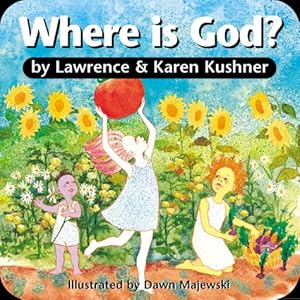
Where is God? by Lawrence and Karen Kushner

A review by B Keeper on Amazon.com says it all really:
Kushner's Where Is God is a wonderful introduction to the concept that God's presence infuses nature and all human exchanges and experiences. I actually prefer this board book to the full-size, older-children's book it is drawn from (Because Nothing Looks Like God), because the board book forces one to linger on the poetry of the text and the tenderness of the cropped illustrations. I get choked up almost every time I read this little book to my two-year-old son, simply because it is so simple and so true, and because I feel it expresses exactly my belief about God's immanance and the joys of being human here on earth.
Lawrence Kushner is a Reform rabbi and currently the scholar-in-residence at Congregation Emanu-El in San Francisco, California.

Amazon.co.uk · Lawrence Kushner


Jonathan Livingston Seagull by Richard Bach

An absolute classic ever since it was published, Jonathan Livingston Seagull is the story of a gull who is not like other gulls. He lives to fly rather than to eat. Eventually he is shunned by the other gulls, until some come to learn from him. This is a story of individuality and courage, beautifully illustrated with pictures of gulls in flight.

GoodReads says:
People who make their own rules when they know they're right...people who get a special pleasure out of doing something well (even if only for themselves)...people who know there's more to this whole living thing than meets the eye: they'll be with Jonathan Seagull all the way. Others may simply escape into a delightful adventure about freedom and flight.

Longer books for older children


The Earthsea Quartet by Ursula Le Guin

This is a wonderful series of books on how to use magic responsibly, with unforgettable characters, beautiful seascapes, and an excellent style of writing. The author is a Taoist, and the philosophy of Taoism is evident in the unfolding of the story (but never in a heavy-handed way).

Ged, a mage from a remote island, goes to wizard school on Roke, but one day when he is showing off his powers to the other students, he brings a terrible thing into the world: a gebbeth. He must go on a quest to track it down. On his journey, he has wonderful adventures and meets a dragon and an unhappy priestess.

Amazon.co.uk · Fantasy Book Review · Ursula K Le Guin


Witch Child by Celia Rees

Aimed at teenagers, this is a story of a girl whose grandmother is hanged for witchcraft, and who must then make her own way in a world of fear and superstition. Celia Rees writes beautifully of landscapes and customs, but the book is gripping from start to finish.  There's also a sequel, Sorceress.
"compelling and convincing.Rees has become a major writer for teenage readers." Independent 
"every now and then one reads a book which stirs up the deepest of feelings and continues to cause ripples and this book is just such a one" School Librarian Journal
Amazon.co.uk · Celia Rees

The Secret Life of Bees by Sue Monk Kidd

Lily is a lonely motherless girl who lives in South Carolina and is visited by bees. After her friend Rosaleen is beaten up for registering to vote, they run away and find happiness from an unexpected connection from the past.

This novel has also been made into a film directed by Gina Prince-Bythewood.

Amazon.co.uk · Sue Monk Kidd