Showing posts with label spirituality. Show all posts

Friday, 30 September 2011

More spiritual books for kids

After I posted the previous article about spiritual books for kids, lots of people suggested more books that I had forgotten to include. And some of them were my favourite books.

The Secret Garden by Frances Hodgson Burnett

This is a story of an orphaned girl who discovers the beauty of the Yorkshire Moors, the value of friendship, and the magic of gardening. The main characters - Mary, the protagonist, Dickon the child of Nature, and Colin the intellectual are unforgettable; and the minor characters such as Ben the gruff gardener and Dickon's mother, are beautifully drawn too.

The Moomin series by Tove Jansson

Moominvalley is located on the edge of the Gulf of Finland, and the creatures that live there include Moomins, Hemulens, Fillyjonks and their friends. They have a series of adventures; the stories mostly focus on Moomintroll and his friendship with Snufkin, who is a wanderer who doesn't like to have too many possessions, and is almost Zen Buddhist in his thinking. The whole series has a wistful and charming tone, a keen observation of Nature, and the books are beautifully illustrated.

The Iron Wolf by Richard Adams

This is a collection of folktales from all around the world, rewritten for children. One of my favourites is an Italian story about how the birds got their colours, but all the stories are well-written and enjoyable.
'Authors need folk-tales,' Richard Adams says, 'in the same way as composers need folk-song. They're the headspring of the narrator's art, where the story stands forth at its simple, irreducible best. They don't date, any more than dreams, for they are the collective dreams of humanity.'
Watership Down by Richard Adams

The gripping story of the journey of five rabbits who escape the destruction of their home warren after Fiver (a shaman-rabbit) has a vision of its impending doom. The friendship of the rabbits, the visionary experiences of Fiver, and the legends of El-Ahrairah, the trickster rabbit hero (who bears more than a passing resemblance to human trickster gods), make this a magical and unforgettable story.

Strandloper by Alan Garner

The story opens with a group of people holding a curiously pagan folk ritual in a church. One of them, William Buckley, has learnt to read, which is regarded as a subversive crime; and he is transported to Australia for blasphemy, where he escapes from the penal colony and goes to live with Aborigines. This is a very evocative look at the similarities and differences between English folk mythology and Australian Aborigine mythology, and the differences between folk religion and revealed religion. The English section of the story is based fairly closely on the facts.

Hide and Seek with God by Mary Ann Moore, Skinner House, 1994
- 29 enchanting tales for four- to eight-year-olds.
- For today's children, a religious vision that is multicultural and non-sexist.
- Includes suggestions for talking about God with children without using dogma
- God comes to life as many things — transcendent mystery, spiritual force, the mother and father of life, peace, and silence, and lightness and darkness.

Friday, 16 September 2011

Spiritual books for kids

Do you ever wonder how to introduce your kids to spirituality without pushing it on them? Of course, they'll quite probably discover it for themselves, but maybe they won't mind a helping hand.

Here are some of the books that I found inspiring as a child, and some that I have discovered since.

Illustrated books for younger children


The Little Prince by Antoine de Saint-Exupéry

I love this book so much that I bought the French edition as well (it was originally written in French). It's a poignant story of how an aviator who has crashed in the desert meets a traveller from another planet - the little prince who lives on the asteroid B612. The little prince tells of his travels from one asteroid to another. The story is quirky and charming, but also sad and wistful.

Google Books · Wikipedia


The Whales' Song by Dyan Sheldon and Gary Blythe

This is a lovely book with beautiful illustrations and the evocative story of Lily, a small girl who lives with her grandmother. Her grandmother tells her stories about the whales, and how beautiful they are.

It is presumably meant to be read aloud to small children, but it is enjoyable for all ages.

Amazon.co.uk · GoodReads


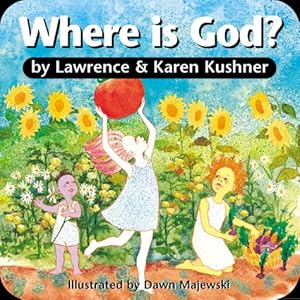
Where is God? by Lawrence and Karen Kushner

A review by B Keeper on Amazon.com says it all really:
Kushner's Where Is God is a wonderful introduction to the concept that God's presence infuses nature and all human exchanges and experiences. I actually prefer this board book to the full-size, older-children's book it is drawn from (Because Nothing Looks Like God), because the board book forces one to linger on the poetry of the text and the tenderness of the cropped illustrations. I get choked up almost every time I read this little book to my two-year-old son, simply because it is so simple and so true, and because I feel it expresses exactly my belief about God's immanance and the joys of being human here on earth.
Lawrence Kushner is a Reform rabbi and currently the scholar-in-residence at Congregation Emanu-El in San Francisco, California.

Amazon.co.uk · Lawrence Kushner


Jonathan Livingston Seagull by Richard Bach

An absolute classic ever since it was published, Jonathan Livingston Seagull is the story of a gull who is not like other gulls. He lives to fly rather than to eat. Eventually he is shunned by the other gulls, until some come to learn from him. This is a story of individuality and courage, beautifully illustrated with pictures of gulls in flight.

GoodReads says:
People who make their own rules when they know they're right...people who get a special pleasure out of doing something well (even if only for themselves)...people who know there's more to this whole living thing than meets the eye: they'll be with Jonathan Seagull all the way. Others may simply escape into a delightful adventure about freedom and flight.

Longer books for older children


The Earthsea Quartet by Ursula Le Guin

This is a wonderful series of books on how to use magic responsibly, with unforgettable characters, beautiful seascapes, and an excellent style of writing. The author is a Taoist, and the philosophy of Taoism is evident in the unfolding of the story (but never in a heavy-handed way).

Ged, a mage from a remote island, goes to wizard school on Roke, but one day when he is showing off his powers to the other students, he brings a terrible thing into the world: a gebbeth. He must go on a quest to track it down. On his journey, he has wonderful adventures and meets a dragon and an unhappy priestess.

Amazon.co.uk · Fantasy Book Review · Ursula K Le Guin


Witch Child by Celia Rees

Aimed at teenagers, this is a story of a girl whose grandmother is hanged for witchcraft, and who must then make her own way in a world of fear and superstition. Celia Rees writes beautifully of landscapes and customs, but the book is gripping from start to finish.  There's also a sequel, Sorceress.
"compelling and convincing.Rees has become a major writer for teenage readers." Independent 
"every now and then one reads a book which stirs up the deepest of feelings and continues to cause ripples and this book is just such a one" School Librarian Journal
Amazon.co.uk · Celia Rees

The Secret Life of Bees by Sue Monk Kidd

Lily is a lonely motherless girl who lives in South Carolina and is visited by bees. After her friend Rosaleen is beaten up for registering to vote, they run away and find happiness from an unexpected connection from the past.

This novel has also been made into a film directed by Gina Prince-Bythewood.

Amazon.co.uk · Sue Monk Kidd

Monday, 22 August 2011

What is spirituality?

Spirituality has memorably been described by Lucy Bregman as "a glowing and useful term in search of a meaning".

So, what is it? Does it imply the existence of a spirit or a soul, or of deities? No, not necessarily. You can be spiritual without being religious (and you can be religious without being spiritual). Religion is often regarded as outward conformity to a particular religious system, its beliefs, practices and values, whereas spirituality is the inner sense of connection, a more instinctive and intuitive way of life.

I regard spirituality as a sense of mystical connection with the universe and all beings within it. It can be inspired by nature, science, art, poetry, liturgy and ritual. In feeling this sense of connection, we experience compassion for the sufferings of other beings, and empathy with their joys.

We can enhance this sense of connection by finding a community with whom we can practice compassion and mindfulness; if we don’t engage in spirituality in a community setting, it can become self-centred and shallow, disconnected from everyday reality. We need the experience of actually living and sharing with others to enable us to grow and become our authentic selves. This can be done by the creation of a community of shared values, which models in microcosm the desired qualities of human community. Of course there will be conflicts and tensions, but it is in how these are resolved that the real values of the community will be tested and refined. It is only by this kind of radical openness and humility that the spiritual community can become strong and genuinely inclusive.

Practising spirituality in community could be called religion (a word that simply means to reconnect, or to reinterpret). In liberal religion, where the "divine" is usually viewed as immanent in the world, or as so diffuse that it's not a person, the source of authority is viewed as the self (as in one's conscience) and not a "higher power". Adherents of liberal religions (such as Unitarians, Pagans, Quakers, Buddhists, Liberal Jews and many others) regard differences of belief as interesting and stimulating, challenging us to broaden our minds. Mysticism, spirituality and spiritual practices are encouraged in these traditions.

Thursday, 18 August 2011

New resources on UKSpirituality

New resources in Atheist Spirituality:
A new addition to the Buddhist quotations section:
Do not believe in anything (simply) because you have heard it.
Do not believe in traditions because they have been handed down for many generations.
Do not believe in anything because it is spoken and rumored by many.
Do not believe in anything (simply) because it is found written in your religious books.
Do not believe in anything merely on authority of your teachers and elders.
But after observation and analysis, when you find that it agrees with reason, and is conducive to the good and benefit of one and all, then accept it and live up to it.

~ Gotama Buddha
It would be great to add more to the atheist spirituality section, so if you have a suggestion, please send it in.

Friday, 29 July 2011

Spiritual practices: grounding and centring

Many rituals begin with this simple practice, especially Pagan circles. It comes from the Taoist tradition originally, I think. There are several different versions of it.

Its purpose is to allow you to feel connected to the Earth (grounded), not floating away into fantasy-world, not obsessing about the past or the future, but being present in the now. The centring part of the practice allows you to feel connected to the cosmos and the four sacred directions, which are associated with the elements.

Begin by focusing on your breathing. Don't breathe in any special way, just notice how your breath comes in and out of your nostrils, and how your belly rises and falls.

As you breathe in and out, feel your feet planted firmly on the ground. Relax your hips and your knees and imagine a thread extending from the top of your head to the centre of the sky (this helps to align your spine with the axis of the Earth).

Imagine that your feet are tree roots, and extend your roots deep into the earth. Your roots push down into the earth, through the rich soil, finding their way among rocks, and down deep into the molten core of the Earth. As you breathe out, extend your roots; as you breathe in, draw up energy from deep within the Earth.

As the energy makes its way into your body, draw it up through your legs and feel it gathering and pooling in your solar plexus. Note the colour of the energy.

Now extend a tendril of energy up your spine. Imagine that your spine is the trunk of a tree, and extend your aura at the top of your head, growing branches. Extend your branches up into the sky, beyond the atmosphere, and reach for the energy of the starlight. As you breathe out, extend your branches; as you breathe in, draw the energy down from above. Feel it gathering and pooling in your solar plexus, mingling with the energy from below.

Now draw energy from both above and below at the same time, and let the energies mingle in your solar plexus. As you breathe in, draw in the energy from above and below; as you breathe out, feel it spiralling and swirling.

Now allow the energy to fill your whole body, extending out to your feet, your fingertips, the top of your head. Feel how you are aligned with the cosmic axis.

Now acknowledge the four directions: North for Earth, representing the body, sensation, physicality, and structure; East for Air, representing intellect, thought, inspiration and breath; South for Fire, representing passion, intuition, and spirit; and West for Water, representing emotion, the Moon, dreams, and the blood that flows in your veins.

Saturday, 14 May 2011

New resources area

We're very excited because we have just created a new resources area for the UKSpirituality site. It includes resources from several different traditions, and you can suggest a resource as well. We hope to build up a database of resources for people to use in their rituals and services.

Resources are organised into the following categories:

Friday, 11 March 2011

Centring prayer

Many people do not believe in a personal God or in miraculous interventions, so we find it difficult to pray. But prayer is not just about asking for things. It can be contemplative. It can be about communing silently with the universe, or self-examination, or holding loved ones in your thoughts, or increasing mindfulness.

Centring prayer is a spiritual practice that was developed by Christians in response to interfaith dialogue with Buddhists.

The practice involves choosing a word that expresses a positive quality of the Divine (whatever you conceive that to be), such as love, peace, joy, silence, creativity.

Take a moment to decide what this quality means for you; now hold the word, or an image that represents it for you, in your mind and in your heart. Just focus on that concept; don’t worry if your mind drifts off – don’t follow the train of thought, just bring your mind gently back to the concept.

As you breathe in and out, you can say the word silently to yourself, trying to experience the quality it describes.

Ideally, the prayer will reach the point where you are not engaged in their thoughts as they arrive on your stream of consciousness.

Sunday, 26 December 2010

UKSpirituality Forum

The new UK Spirituality Forum is up and running. We hope that people will use it to discuss spirituality, share and explore spiritual practices, keep in touch with other members and event attendees, give feedback on events, and make new friends.

Saturday, 18 December 2010

Spirituality is Simple!

Someone asked me recently what spirituality is all about.

This is the life I am blessed to lead in vital north London: I am surrounded by people who don't bring a load of biases and preconceptions when it comes to their interest in religion and spirituality. I certainly came to it with those biases from traditional religion!

Many, many people come to religion with wounds an burdens. My ministry is rather different. It is so freeing not to have to begin such a discussion with "no, I don't meanthat", where that is something that was taught to them early on and presented in an inflexibly doctrinaire manner.

So, I considered this fresh, unbiased question from a young adult who has grown up in a surprisingly secular western Europe. Every time someone asks something like that I think of it anew – partly because my memory is so bad that I can't possibly remember what I answered last time, but also partly because my perspectives continually change as I grow and (hopefully) mature.

I don't know what I said last time, but this time I suggested that spirituality is about two simple ways of being: awareness and appreciation. Maybe they're not quite so simple though. In fact, I want to use both of those words in their most expansive forms.

Awareness is not simply the state of being 'not blind' to everything around us, but rather a condition where our senses are almost tingling and reaching out to take in everything – to catch the smells and sights and sounds around us - everything – good and bad - and especially to take in our fellow beings.

And by appreciation I want to go much farther than the positive but superficial sense of “I really appreciated the card you sent” but rather the sense of that word as a full understanding of the meaning and importance. Appreciation is joy at seeing a flower. It is a feeling of awe at taking in a view of the clear night sky. It is sharing a sense of another person’s sadness to the extent that you feel it in your own guts.

Spirituality as awareness and appreciation connects us to each other. It connects us to everything around us. It brings us joy and sadness and allows us to live deeply and fully.

And that's the goal. That's the way of being that we're after in the spiritual pursuit.

What is the path to approach this goal? Ha! Trick question... I'm a Unitarian. There are many valid paths. These two qualities - awareness and appreciation - have been the goals of many spiritual teachings. Meditation is an obvious tool for increasing awareness. Prayer a well-known approach to increasing our appreciation. Praying five times daily as Muslims do or uttering a blessing for almost every act of the day as do Orthodox Jews - the potential to grow in a awareness and appreciation is enormous.

Some will disagree. The goal of spirituality, they may say, is to know God. Well, then, we must ask what it is to know this God? What is the effect of knowing God. Hafiz - the 14th century Persian Sufi mystic - tells us that the true vision of God can be identified as one that makes you "more human, more kind to every creature and plant that you know."*

Do you have a better definition of spirituality? I'd love to hear about it.


*Translated by Daniel Ladinsky